Audio Feedback Loops in Digital: Cybernetic Music in Symbolic Sound Kyma 7

Building some feedback loops in the digital domain using Symbolic Sound’s Kyma 7.

In audio feedback loops, the output of the system is fed back into an input. We’re probably most familiar with this when we put a microphone in front of a speaker and we get the “howling” sound. Here, though, I’m intentionally building digital feedback loops in order to explore the sonic possibilities of these rather unpredictable systems.

In order to keep my feedback loop interesting, though, I need to keep it from dying away to silence, or blowing up into white noise. By considering the different processes we apply to the audio in the loop (are they adding spectral complexity or removing it?), we can try to make feedback patches that are dynamic and interesting over time.

0:00 The Continuum of Spectral Complexity
3:13 Staring with an Sine Wave in Kyma
4:45 Delay with Feedback
5:49 Building Feedback Loops Manually
8:40 Ring-Modulating the Feedback
11:20 Gain and Saturation
14:22 Exploring the Sound
16:16 Filter Bank
19:05 Jamming with the Patch
22:18 Thinking about Control
23:25 Performing the Sound
26:34 Feedback Loop with Reverb
28:10 Making it into IDM with the Chopper
29:22 So What? Next Steps

More Kyma Videos:

More audio cybernetics and feedback:

Making a Bad Sine Wave in Pure Data Vanilla

Building a “wab-sabi” oscillator in Pd to celebrate the beauty of imperfection and impermanence.

Sine waves are great! The perfection of a pure, single frequency can be both expressively and technically very useful in pursuing our musical goals. There are, however, lots of musical reasons that we might want to intentionally make our oscillators a little more rough around the edges.

Performance on traditional, acoustic instruments, of course, produces a huge amount of micro-variation across each note, and so it can be expressively engaging for us to be able to introduce that same imperfection (analog warmth?) in our digital instruments as well.

In this video, I build a bad sine wave by frequency-modulating my oscillator with noise, and then feeding back the output back into the modulation. While I build this out in Pure Data, the same can be done in Reaktor, Kyma, Max/MSP or any other synthesis environment.

More Pd Tutorials here.
No-talking Pure Data jams and patch-from-scratch.

0:00 Introduction, The Beauty of Imperfection
1:26 Slider-Controlled Sine Wave
3:28 Adding Noise
4:35 Frequency Modulating with Noise
7:24 Filtering the Noise
8:20 Feeding Back into FM
9:55 I’ve gone too far
13:26 Reaktor Examples
14:18 Closing Thoughts, Next Steps

New Music: “Cybernetics & Feedback”

I’ve released a new collection of pieces, “Cybernetics & Feedback”, available on bandcamp:

Cybernetics & Feedback

Inspired by the cybernetic and feedback works of Roland Kayn, Éliane Radigue, Bebe Barron, and Jaap Vink, and embracing an anything-goes noise music aesthetic, this collection of works from early 2022 explores analog feedback loops and self-regulating patches in Eurorack modular.

In these pieces, audio signals are routed back into themselves, and used to control processes and trigger events. While these are performed improvisations, “performance” in this case does not mean strict control, since these systems influence themselves as much as the performer does.

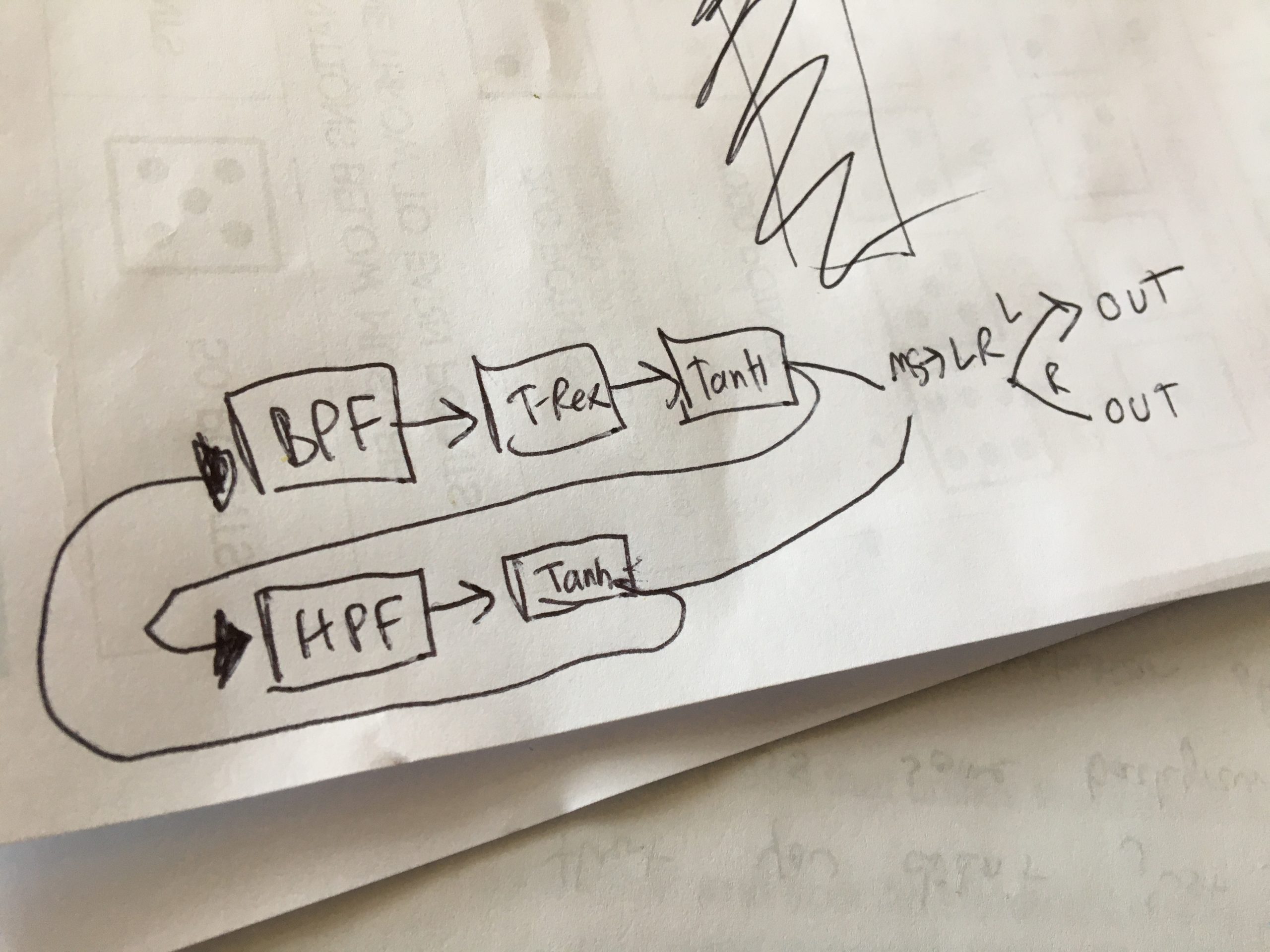
One of my sketches. I think this is Track 6.

A quick acknowledgement that these noisy soundscapes might not be for everyone. Don’t worry. I won’t be offended.

I do have something a little more crowd-pleasing:

Ambient Chiptune (for Studying)

As a bonus, I’ve put up all the audio tracks from my “Ambient Chiptune” videos as a free/pay-what-you-want download.

(Definitely easier listening on these!)

Enjoy!

Eurorack Neural Network Jam: “An Explanation of the Universe”

A mess of Eurorack CV feedback that’s not random. It’s chaotic!

This instrument creates chaotic synthesized music that I interact with using four knobs. The music that this synthesizer creates is not random. It is determined by a set of “rules” created by the different components interacting with each other. However, because each of these modules influences and is influenced by several others, the interconnected network of interactions obfuscates the rules of the system. This leads to the instrument’s chaotic, incomprehensible behavior.

As with all chaotic systems, though, if it were possible to understand all of the different components and their relationships, and do complex enough calculations, we would be able to predict the outcome of all of our interactions.

Patch notes: ….Uh…. I just kept patching things back into each other, and this is where I ended up.

Audio Resonance (Acoustics, Synthesis, Feedback, and Sonic Aesthetics)

A quick overview of principles and aesthetics audio “resonance” in filters and beyond.

In synthesis, we often encounter resonance controls on our filters, both digital and analog, but, more broadly speaking audio resonance the property of any device, space, or system to increase the amplitude of particular frequencies.

So what? Well, that’s a good question. Here I offer some different examples of resonance, both acoustic and electroacoustic, and perhaps there are some avenues there for you to explore in your own music and sonic art.

0:00 Defining “Resonance”
0:50 I Am Sitting in a Room
1:11 Breaking a Wine Glass
1:39 “That Really Resonated with Me”
1:56 Resonant Bodies of Instruments
2:11 Feedback Loops
2:36 Resonance as Metaphor
3:09 Where’s the Art?

More fundamentals of sound synthesis:

Synthesis, Cybernetics, and Feedback

In my recent explorations of analog synthesis (as a former dyed-in-the-wool digital synthesist), I’ve found that feedback loops are one of the things that particularly different to explore in analog.

Inspired by the YouTube channel, La Synthèse Humaine, I’ve been doing a lot of feedback patches in Eurorack, with no-input mixing, FX pedals, and even digitally in Pure Data.

Better explained on the La Synthèse Humaine channel, “cybernetics” here follows Norbert Wiener’s definition: “control and communication in the animal and the machine,” since these audio feedback systems are “self-regulating” (self-controling?) sonic ecosystems.

Anyway, I’ve put together a playlist of my improvisations, collaborations, and ramblings about feedback and cybernetic systems. Enjoy!

Internet-Based Feedback Loops: Eurorack vs. Zoom (with Spectral Evolver)

Using the latency from videoconferencing software as a delay for Eurorack feedback loops, creating (noisy) evolving sonic textures.

I’m in Connecticut, Spectral Evolver  is in Colorado, but that doesn’t mean we can’t connect our Eurorack systems.

Through the “magic” of Zoom, we create a feedback loop: I’m ring modulating the signal coming in from Zoom, he’s filtering the signal coming in on his end. This creates a “no-input” system across the world wide web, allowing us to create evolving textures inspired by Dutch composer Jaap Vink.

More on feedback loops and cybernetic systems here:

Pd Patch from Scratch: Ring Modulation and Filterbank

A quick and easy Pure Data patch-from-scratch tutorial building another feedback loop with a delay and a ring modulator, this time with a fixed filter bank.

Inspired by the music of Jaap Vink, with three sine waves, a filterbank, a delay, and some feedback, we can make some slow evolving-complex and dynamic sounds.

In this patch we take a sine wave, ring modulate it, then ring modulate that result before running into a filterbank, delay, and then feeding it back on itself.

There’s no talking on this one, just building the patch, and listening to it go.

More feedback loops (in analog):

Pure Data Ring-Modulation Delay

A quick and easy Pure Data patch-from-scratch tutorial building a feedback loop with a delay and a ring modulator.

With just two sine waves, a delay, and some feedback, we can make some pretty complex and dynamic sounds! In this patch we take a sine wave, delay it, and then ring-modulate that delay before feeding it back on itself (feeding it back into the delay, that is).

There’s no talking on this one, just building the patch, and listening to it go.

More Pd Tutorials
More on modulation synthesis