Listening to electromagnetic radiation around the house using a homemade elektrosluch.
I was cleaning up, and found an “elektrosluch” that I made a few years back, and figured I’d dust it off and make sure that it still works. This is a device designed by LOM-Instruments that converts the vibration electromagnetic fields into sound (specifically vibrations of voltage that we can listen to through headphones, more info here ).
Adding envelopes to our synthesizer that aren‘tan ADSR.
ADSRs might be the envelope generators that we encounter most often, but they’re not the only way to shape our sound. There are a number of other musical ways to craft change in our synthesizer over time with these non-periodic TVCs.
Let’s check out what other options there are in Reaktor 6 primary.
Coding (well, “patching”) an artificial neural network in Pure Data Vanilla to create some generative ambient filter pings.
From zero to neural network in about ten minutes!
In audio terms, an artificial neuron is just a nonlinear mixer, and, to create a network of these neurons, all we need to do is run them into each other. So, in this video, I do just that: we make our neuron, duplicate it out until we have 20 of them, and then send some LFOs through that neural network. In the end, we use the output to trigger filter “pings” of five different notes.
There’s not really any kind of true artificial intelligence (or “deep learning”) in this neural network, because the output of the network, while it is fed back, doesn’t go back an affect the weights of the inputs in the individual neurons. That said, if we wanted machine learning, we would have to have some kind of desired goal (e.g. playing a Beethoven symphony or a major scale). Here, we just let the neural network provide us with some outputs for some Pure Data generative ambient pings. Add some delay, and you’re all set.
There’s no talking on this one, just building the patch, and listening to it go.
0:00 Demo 0:12 Building and artificial neuron 2:00 Networking our neurons 3:47 Feeding LFOs into the network 4:20 Checking the output of the network 5:00 Pinging filters with [threshold~] 8:55 Adding some feedback 10:18 Commenting our code 12:47 Playing with the network
Creating an artificial neuron in Pd:
Pinging Filters in Pd:
More no-talking Pure Data jams and patch-from-scratch videos:
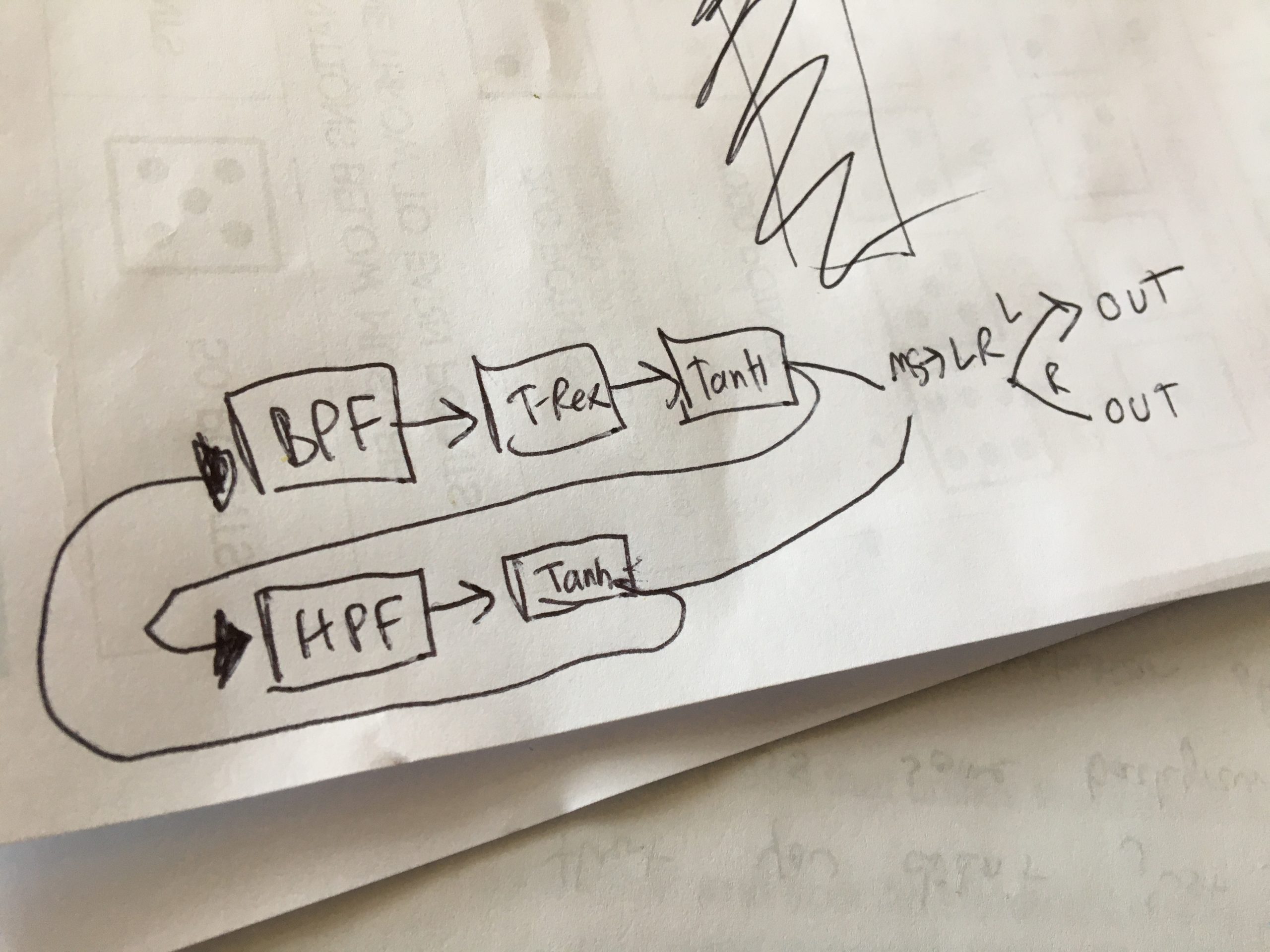
A simple digital feedback patch in Pure Data build from just delay, ring-modulation, and saturation.
Building on my digital feedback video from a few weeks ago, here’s a quick patch for setting up a dynamic controllable feedback loop in Pd Vanilla. I’ve set up a way to get things going with a little sine-wave beep, and you can hear that the feedback loop makes things pretty complex pretty quickly. WATCH THOSE LEVELS! It gets loud in the middle.
Recently, I’ve been hooked on the idea of neurons and electronic and digital models of them. As always, this interest is focused on how these models can help us make interesting music and sound design.
It all started with my explorations into modular synths, especially focusing on the weirdest modules that I could find. I’d already spent decades doing digital synthesis, so I wanted to know what the furthest reaches of analog synthesis had to offer, and one of the modules that I came across was the nonlinearcircuits “neuron” (which had the additional benefit that it was simple enough for me to solder together on my own for cheap).
Anyway, today, I don’t want to talk about this module in particular, but rather more generally about what an artificial neuron is and what it can do with audio.
I wouldn’t want to learn biology from a composer, so I’ll keep this in the most simple terms possible (so I don’t mess up). The concept here is that neuron is receives a bunch of signals into its dendrites, and, based off of these signals, send out its own signal through its axon.
Are you with me so far?
In the case of biological neurons these “signals” are chemical or electrical, and in these sonic explorations the signals are the continuous changing voltages of an analog audio signal.
So, in audio, the way we combine multiple audio source is a mixer:
Three signals in, One out
Now, the interesting thing here is that a neuron doesn’t just sum the signals from its dendrites and send them to the output. It gives these inputs different weights (levels), and combines them in a nonlinear way.
In our sonic models of neurons, this “nonlinearity” could be a number of things: waveshapers, rectifiers, etc.
Hyberbolic Tan Function (tanh)
In the case of our sonic explorations, different nonlinear transformations will lead to different sonic results, but there’s no real “better” or “worse” choices (except driven by your aesthetic goals). Now, if I wanted to train an artificial neural net to identify pictures or compose algorithmic music, I’d think more about it (and there’s lots of literature about these activation function choices).
But, OK! A mixer with the ability to control the input levels and a nonlinear transformation! That’s our neuron! That’s it!
Just one neuron
In this patch, our mixer receives three inputs: a sequenced sine wave, a chaotically-modulated triangle wave, and one more thing I’ll get back to in a sec. That output is put through a hyperbolic tan function (soft-clipping, basically), then run into a comparator (if the input is high enough, fire the synapse!), then comparator is filtered, run to a spring reverb, and then the reverb is fed back into that third input of the mixer.
Now, as it stands, this neuron doesn’t learn anything. That would require the neuron getting some feedback from it’s output (it feeds back from the spring reverb, but that’s a little different) Is the neuron delivering the result we want based on the inputs? If not, how can it change the weights of these inputs so that it does?
Building some feedback loops in the digital domain using Symbolic Sound’s Kyma 7.
In audio feedback loops, the output of the system is fed back into an input. We’re probably most familiar with this when we put a microphone in front of a speaker and we get the “howling” sound. Here, though, I’m intentionally building digital feedback loops in order to explore the sonic possibilities of these rather unpredictable systems.
In order to keep my feedback loop interesting, though, I need to keep it from dying away to silence, or blowing up into white noise. By considering the different processes we apply to the audio in the loop (are they adding spectral complexity or removing it?), we can try to make feedback patches that are dynamic and interesting over time.
0:00 The Continuum of Spectral Complexity 3:13 Staring with an Sine Wave in Kyma 4:45 Delay with Feedback 5:49 Building Feedback Loops Manually 8:40 Ring-Modulating the Feedback 11:20 Gain and Saturation 14:22 Exploring the Sound 16:16 Filter Bank 19:05 Jamming with the Patch 22:18 Thinking about Control 23:25 Performing the Sound 26:34 Feedback Loop with Reverb 28:10 Making it into IDM with the Chopper 29:22 So What? Next Steps
Performance on traditional, acoustic instruments, of course, produces a huge amount of micro-variation across each note, and so it can be expressively engaging for us to be able to introduce that same imperfection (analog warmth?) in our digital instruments as well.
In this video, I build a bad sine wave by frequency-modulating my oscillator with noise, and then feeding back the output back into the modulation. While I build this out in Pure Data, the same can be done in Reaktor, Kyma, Max/MSP or any other synthesis environment.
0:00 Introduction, The Beauty of Imperfection 1:26 Slider-Controlled Sine Wave 3:28 Adding Noise 4:35 Frequency Modulating with Noise 7:24 Filtering the Noise 8:20 Feeding Back into FM 9:55 I’ve gone too far 13:26 Reaktor Examples 14:18 Closing Thoughts, Next Steps
Inspired by the cybernetic and feedback works of Roland Kayn, Éliane Radigue, Bebe Barron, and Jaap Vink, and embracing an anything-goes noise music aesthetic, this collection of works from early 2022 explores analog feedback loops and self-regulating patches in Eurorack modular.
In these pieces, audio signals are routed back into themselves, and used to control processes and trigger events. While these are performed improvisations, “performance” in this case does not mean strict control, since these systems influence themselves as much as the performer does.