A quick and easy Pure Data patch-from-scratch tutorial building a “complex oscillator” with two sine waves cross modulating each others frequency for noisy, sophisticated sounds.
In this patch, we set up a simple FM synthesizer with one sine wave modulating another’s frequency. Then, instead of leaving it there, we take our output and use it to modulate the modulation oscillation, leading some wonderful, unpredictable complex sounds.
There’s no talking on this one, just building the patch, and listening to it go.
0:00 Sine Oscillator 0:42 Simple FM Synthesis 1:50 Cross Modulation 2:37 Commenting the Code 4:11 Exploring the Controls
A mess of Eurorack CV feedback that’s not random. It’s chaotic!
This instrument creates chaotic synthesized music that I interact with using four knobs. The music that this synthesizer creates is not random. It is determined by a set of “rules” created by the different components interacting with each other. However, because each of these modules influences and is influenced by several others, the interconnected network of interactions obfuscates the rules of the system. This leads to the instrument’s chaotic, incomprehensible behavior.
As with all chaotic systems, though, if it were possible to understand all of the different components and their relationships, and do complex enough calculations, we would be able to predict the outcome of all of our interactions.
Patch notes: ….Uh…. I just kept patching things back into each other, and this is where I ended up.
I’ve been adding a few videos to freshen up my synthesis and MIDI microlecture series, tuning it up for the coming academic year.
Check it out here for a complete(?) introduction to sound synthesis, from defining sound to modulation synthesis.
These lectures are an adaptation of lectures from a course I’ve been teaching for 13 years. I first taught it as a graduate student at the University of Oregon, then as faculty at the University of Montana, and I currently teach at the University of New Haven.
Of course these lectures have been continuously revised and refined over the years, but the fundamentals of synthesizing sound remain the same.
My students getting started in Kyma often ask me how they can integrate it into music production in their DAW. Now, there are a lot of good reasons to get away from your DAW sometimes, and experiment with different workflows (including those built into Kyma), but let’s set those aside for the moment. With a Dante AVIO USB ($129) and the Dante Virtual Soundcard ($29), you can set up two channels of 48K digital audio in and out of your Paca(rana), enabling you to use it like a plug-in effect with low latency and without any conversion to and from analog.
I demonstrate this in Logic Pro X, but it should work in Pro Tools, Reaper, Ableton, or your other DAW of choice.
Over the last year, I’ve put together a collection of YouTube videos on Pure Data Vanilla for musicians with no previous programming experience required.
Originally, I was just making these videos for a class, but I quickly found there was an audience for Pd tutorials like this, and my videos expanded beyond the class materials to generative music patches, live databending glitch beats, and algorithmic 80s synthwave.
I’ve put together a three-part series on getting started with circuit-bending, from the initial testing and opening up toys to completed alien instrument.
(Part 3 coming next week)
Circuit-bending is the creative customization of consumer electronics with the goal of inventing new unique devices for sound-making, visuals, or other expressive goals. I’m a composer and sound-designer, not an electrical engineer, so my goal is to find fun sounds that I can use in creative ways (rather than any kind of serious circuit design).
For more of my creative electronics projects, check out here:
In order not to bury the lead, let me start by saying, Plurality Spring, a new game piece by me and Paul Turowski, is available for free download:
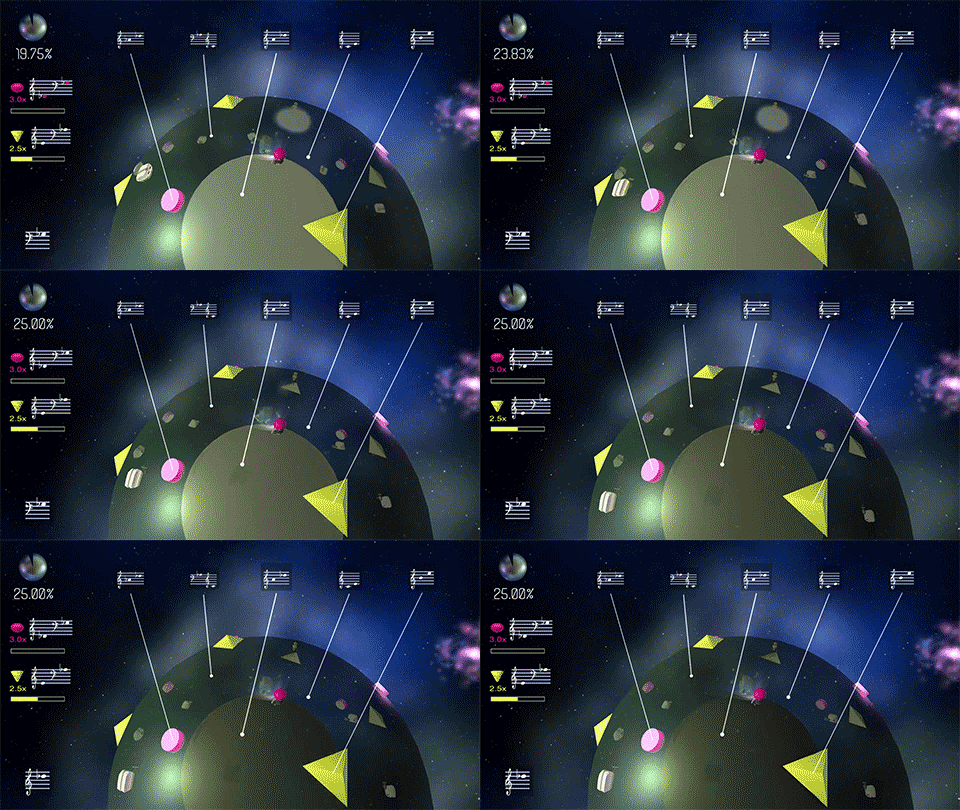
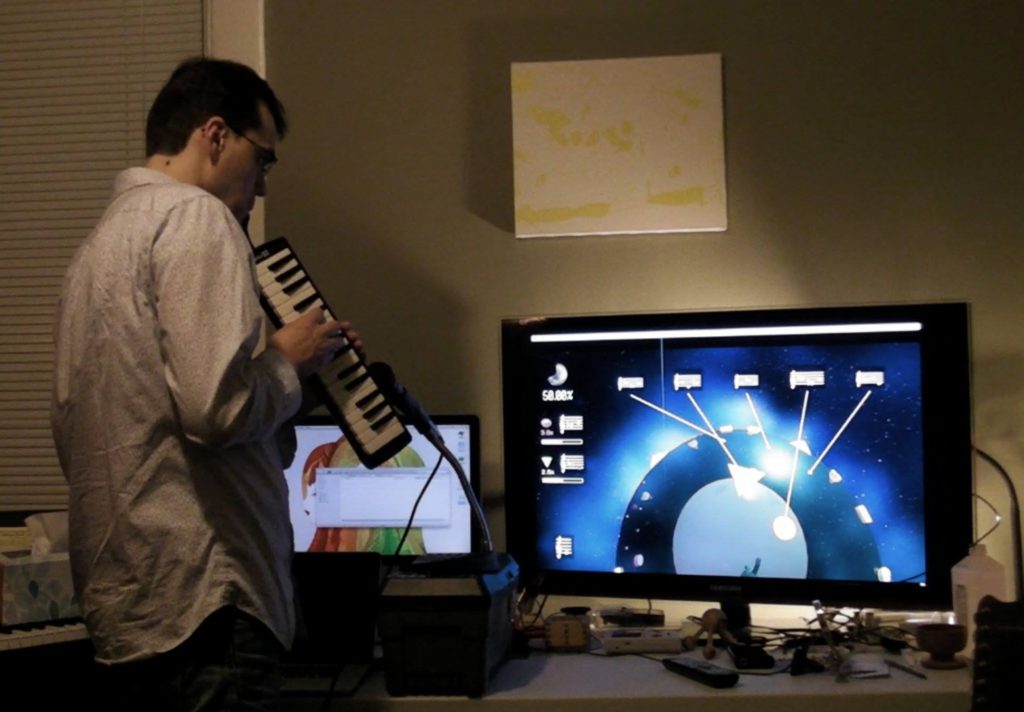
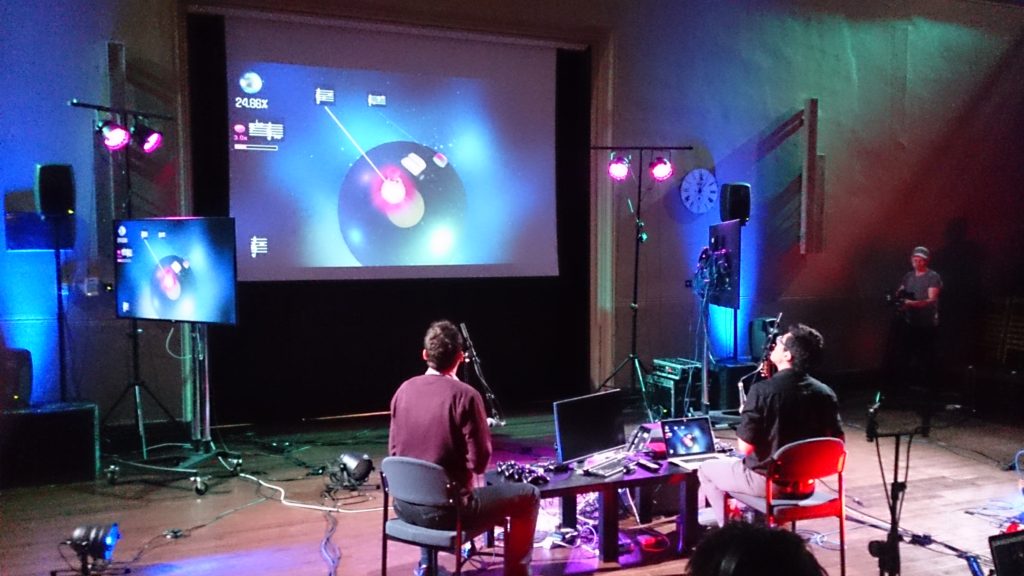
In the game, players use acoustic musical performance (via the computer’s microphone) to control robots exploring an orb in deep space.
This idea of a “game piece,” where an musical work emerges from performers playing within a set of rules, draws from historical models like John Zorn’s Cobra, or Christian Wolff’s For 1, 2, or 3 People. Since Plurality Spring is a digital video game, though, the performers’ live audio mixes with the in-game sound to create a kind of augmented reality performance piece (whether you perform in front of an audience or just on your own).
One of the things that was particularly enjoyable about the collaboration was both of our willingness to be flexible about the game as it evolved.
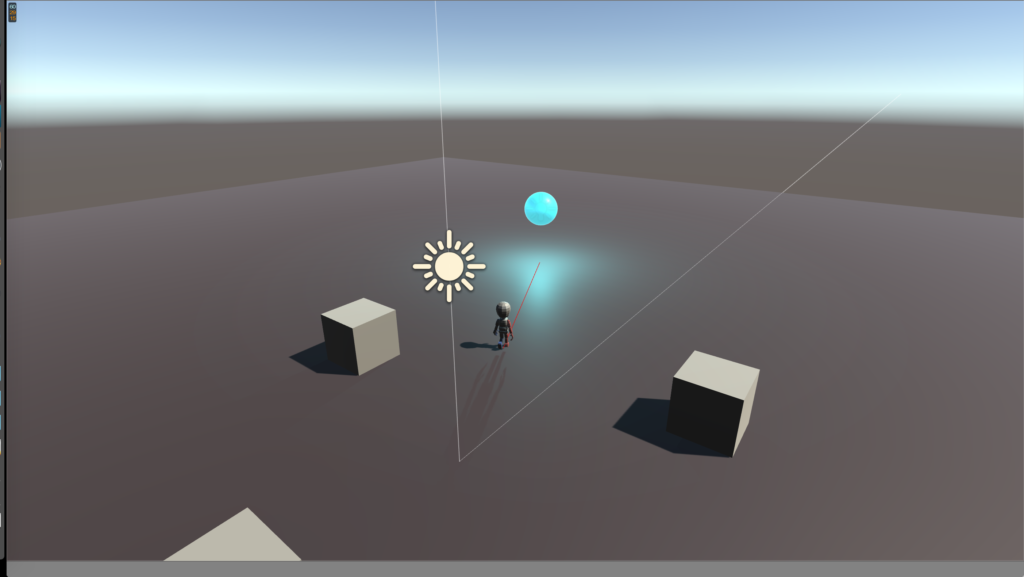
The game was originally about this “kid” following a glowing orb. The players directly controlled the orb, but not the kid.
Here is a screenshot of the early prototype:
It’s cute! It’s neat! But without picking apart our whole creative process (maybe another time…), ultimately we ended up with something very different, and ultimately much better.
Our “kid” became three robots, and the orb is no longer something players chase, it’s a traversable planet. Our aesthetic ideas, too, became much more developed, and we ended up with a really pleasing balance of cute and “gritty” in our final visual and audio design.
The Post Haste Reed Duo‘s debut album, “Beneath a canopy of angels… a River of Stars,” which includes my 2011 work, bioMechanics, has been getting some great press.
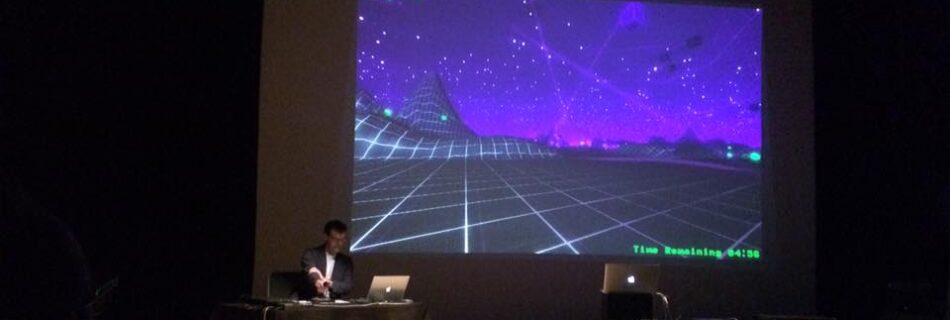
This week, I’m settling in from my trip to Leicester, UK, where I attended the Kyma International Sound Symposium to premiere my new work, Interesting Decisions. The piece is a digital game that creates music through player interaction with a procedurally generated world. In the guise of a retro, neon-packed walking-simulator, Interesting Decisions engages with issues of the homogenizing effects of technology, as well raising questions about new trends of video-game voyeurism.
More thoughts on the Kyma symposium later (I’m still processing an fascinating remark from Christian Vogel where he said “I’ve started thinking of my studio like a network rather than a chain”).
For now, I have some catching up to do.
At the end of my performance in Leicester, the game displayed a message that one could “download the game at simonhutchinson.com” a little prematurely.
Notice that I blame the game for this.
So, with apologies to the delay, here is the game (available in Web, Mac, Windows, and Linux versions):
By necessity, the audio and graphics have been simplified for this standalone version. The piece I performed at the symposium sent OSC messages from the game in Unity to Kyma, and, in order to do a “anyone can play” distribution, I had to bounce out the audio and bring them into Unity, so there’s less nuance in the real-time audio, but I’m sure this is a compromise that game developers must make all the time.
If you’re interested in the original work, you can see a video of a “studio” performance here: