Basic FM Synthesis in Reaktor 6 Primary

Building a basic but expandable FM synthesizer in Reaktor 6, making an FM operators that we can duplicate as much as we want.

In FM synthesis, we modulate the frequency of one oscillator (the carrier) with another oscillator in the audible range. We can make an FM synth in Reaktor that’s modular and quickly expandable if we make a macro with the oscillator, an envelope, and a few special controls at the FM input.

0:00 Intro / What is FM Synthesis?
1:30 Sine Oscillator with Amplitude Envelope
3:14 The “F” Input of Sine FM Oscillators
4:20 Modulating the Frequency
5:24 Modulating the Frequency in the Audible Range
6:13 Adding Musical Controls
11:50 Combining Our FM Operators
13:01 Sideband Modulation with Envelope Control
16:12 Chaining FM Operators Together
19:48 Recap / Next Steps

More beginner Reaktor tutorials here:

Intermediate Reaktor tutorial playlist here:

Eurorack Neural Network Jam: “An Explanation of the Universe”

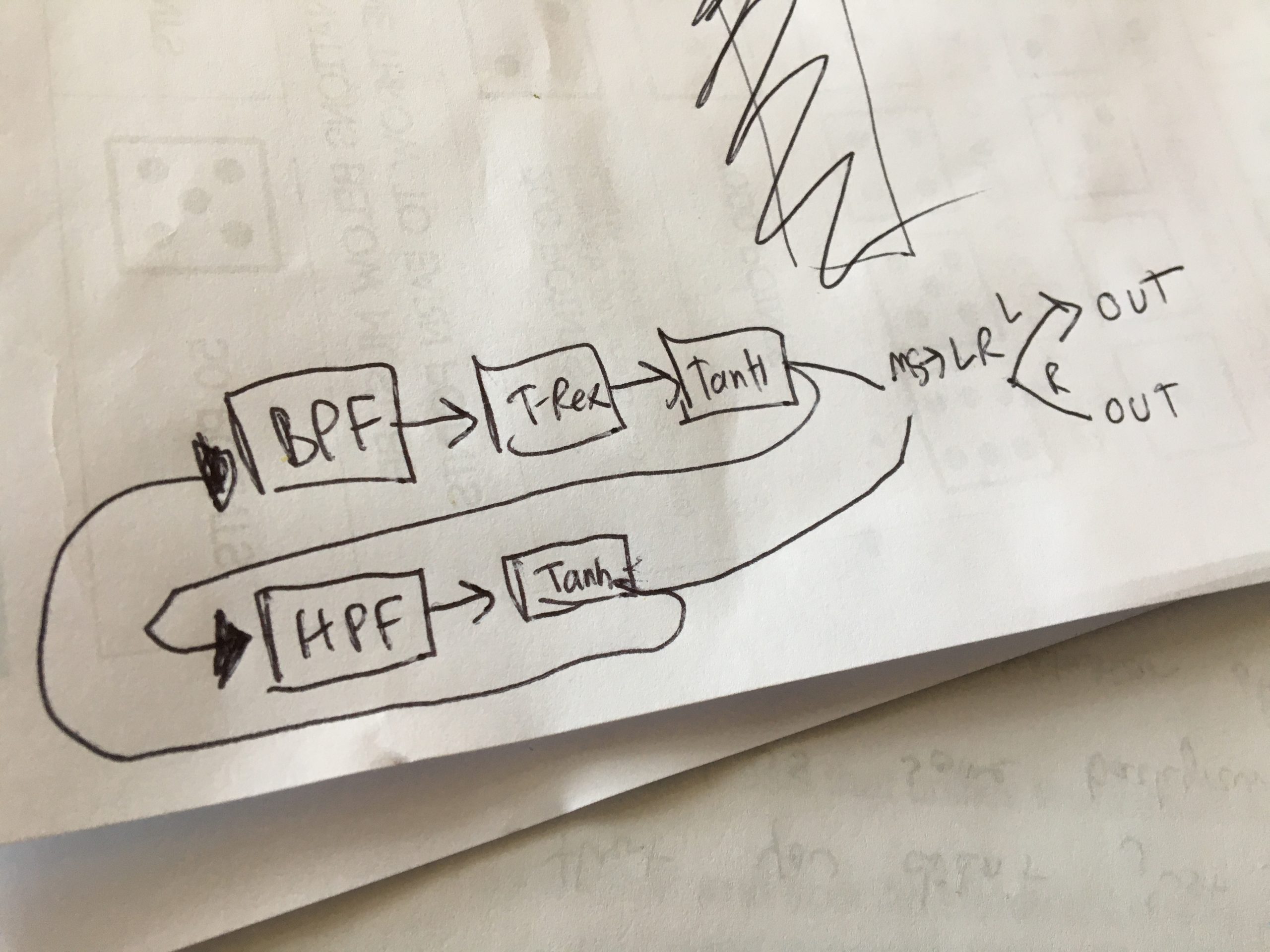
A mess of Eurorack CV feedback that’s not random. It’s chaotic!

This instrument creates chaotic synthesized music that I interact with using four knobs. The music that this synthesizer creates is not random. It is determined by a set of “rules” created by the different components interacting with each other. However, because each of these modules influences and is influenced by several others, the interconnected network of interactions obfuscates the rules of the system. This leads to the instrument’s chaotic, incomprehensible behavior.

As with all chaotic systems, though, if it were possible to understand all of the different components and their relationships, and do complex enough calculations, we would be able to predict the outcome of all of our interactions.

Patch notes: ….Uh…. I just kept patching things back into each other, and this is where I ended up.

Pure Data Patch from Scratch: Simple FM Synthesis Sequencer

A quick and easy Pure Data patch-from-scratch tutorial building a sequencer that plays dynamically changing timbres for each note though frequency modulation synthesis.

In this patch, we set up a simple sequence of sine wave pitches (frequencies), then a sequence of modulation frequencies of a different length, then a random patterns of deviations, creating a constantly changing series of sounds.

There’s no talking on this one, just building the patch, and listening to it go.

0:00 Sequencing the pitch of a sine wave
1:23 Creating modulation oscillator sequence
2:45 Randomizing the deviation
3:15 Audio math: modulator frequency
3:51 Audio math: deviation
4:09 Audio math: FM synthesis
4:31 Tweaking the numbers
4:52 Commenting the code
5:47 Adding delay (as usual)
6:55 Feedback for the delay
7:17 Listening and more tweaking numbers

More no-talking Pure Data jams and patch-from-scratch videos here:

Synthesis, Cybernetics, and Feedback

In my recent explorations of analog synthesis (as a former dyed-in-the-wool digital synthesist), I’ve found that feedback loops are one of the things that particularly different to explore in analog.

Inspired by the YouTube channel, La Synthèse Humaine, I’ve been doing a lot of feedback patches in Eurorack, with no-input mixing, FX pedals, and even digitally in Pure Data.

Better explained on the La Synthèse Humaine channel, “cybernetics” here follows Norbert Wiener’s definition: “control and communication in the animal and the machine,” since these audio feedback systems are “self-regulating” (self-controling?) sonic ecosystems.

Anyway, I’ve put together a playlist of my improvisations, collaborations, and ramblings about feedback and cybernetic systems. Enjoy!

Reaktor 6 Primary Resonant EQ (Faking the Serge Resonant EQ in Reaktor)

Building a resonant EQ in Reaktor Primary, taking inspiration from the Serge Resonant EQ’s unevenly-spaced frequencies and nonlinear controls.

In my regular journeys across the internet, I came across the Random*Source Serge Resonant EQ, a reissue of the resonant EQ from the Serge Synthesizer, and became a bit taken with its implementation and ideas. $400 is a bit too much for an impulse buy, so let’s see what we can do in Reaktor.

Random*Source Serge Resonant EQ

Even if we don’t end up with something that sounds perfect, we can use this as an opportunity to think more about subtractive synthesis, and talk about “parametric support” in our control schemes.

0:00 Purchase Your Way to Music Proficiency!
0:43 Random*Source Serge Resonant EQ
1:14 What’s interesting about this?
2:59 Disclaimer
3:22 Reaktor Primary Peak EQ
5:00 “Boost” vs. “Resonance”
5:53 Making Selectable Sound Sources
8:18 Throwing in an Oscilloscope
8:49 Starting the Resonant EQ Macro
9:28 Creating a Single Band
11:24 Level Controls to Avoid Clipping
13:13 One Knob for Resonance and Boost
14:28 “Funny Math”
21:13 Recapping the Flow / Fine Tuning
22:49 Duplicate! (for each frequency)
23:23 Setting the Frequencies
25:09 Adding a ByPass Switch
25:53 Sound Test
27:14 Saturator
28:04 Waveform Variance Across Instrument Range
29:38 Feedback
35:30 Next Steps

Are There Just 5 Types of Synthesis?

You can find a lot of lists out there on “Synthesis Techniques You Must Know!” These can be pretty compelling, but it can be helpful to take a broader look, and simplify synthesis into 5 big categories:

-Playback and Manipulation of Recorded Audio (Sampling and WT Synthesis)
-Additive Synthesis
-Subtractive Synthesis
-Distortion Synthesis and Modulation Synthesis, and
-Physical-Modeling Synthesis

By zooming out and thinking about these larger ideas, we make synthesis more accessible to people who are starting out, and we give a framework for people who are innovating new synthesis techniques.

0:00 Synthesis isn’t that complicated.
1:03 Five Categories for Synthesis Techniques
1:33 Playback and Manipulation of Recorded Audio
2:34 Additive Synthesis
2:52 Subtractive Synthesis
3:20 Distortion Synthesis (Modulation Synthesis)
4:08 Physical Modeling Synthesis
4:25 So What? / Hybrid Synthesis

More on fundamentals of synthesis here.

Making a “Subharmonicon” in Reaktor

Building a subharmonic synthesizer in Native Instruments’ Reaktor 6 Primary inspired by instruments like the Mixtur-Trautonium and Moog Subharmonicon.

Subharmonics are frequencies that are whole-number divisions of a given frequency (in contrast to harmonics, which are whole number multiples of a frequency). While harmonics naturally occur as part of the timbre of a sound, subharmonics, when introduced, sound like distinct pitches, allowing you to create chords of harmonically-related notes.

This tutorial walks you through making a set of subharmonic oscillators and envelope filter like the ones on the Moog Subharmonicon.

Moog Subharmonicon

More on harmonics and additive synthesis here.

Understanding Granular Synthesis

Explaining granular synthesis and giving demonstrations with the Kyma GrainCloud and SampleCloud sound objects.

Granular synthesis is a synthesis technique where we can assemble new sounds from very short “grains” of sound. We can do this with wavetables or longer samples, breaking them down into these short grains before reconstituting them back together in unique ways. Because we can change all of these tiny parts that make up our new sounds, there are exciting opportunities for real time control and performance.

Subharmonics in Pure Data

Quick and easy Pure Data tutorial, making chords from subharmonics (like the Moog subharmonicon). The result is a kind of Coltrane-y generative music system.

Subharmonics are whole-number divisions of a frequency (as opposed to regular harmonics, which are whole-number multiples of a frequency). The resulting “subharmonic series” (or “undertone series”) is an inversion of the overtone series, with subharmonics getting closer the lower (i.e. higher division) that they are. Played together, these harmonics create harmonies quite distinct from those created with overtones.

I go up to the 9th subharmonic here, but of course you can just keep going.

There’s no talking on this one, just building the patch, and listening to it go.

More Pd Tutorials Here