Understanding Granular Synthesis

Explaining granular synthesis and giving demonstrations with the Kyma GrainCloud and SampleCloud sound objects.

Granular synthesis is a synthesis technique where we can assemble new sounds from very short “grains” of sound. We can do this with wavetables or longer samples, breaking them down into these short grains before reconstituting them back together in unique ways. Because we can change all of these tiny parts that make up our new sounds, there are exciting opportunities for real time control and performance.

Subharmonics in Pure Data

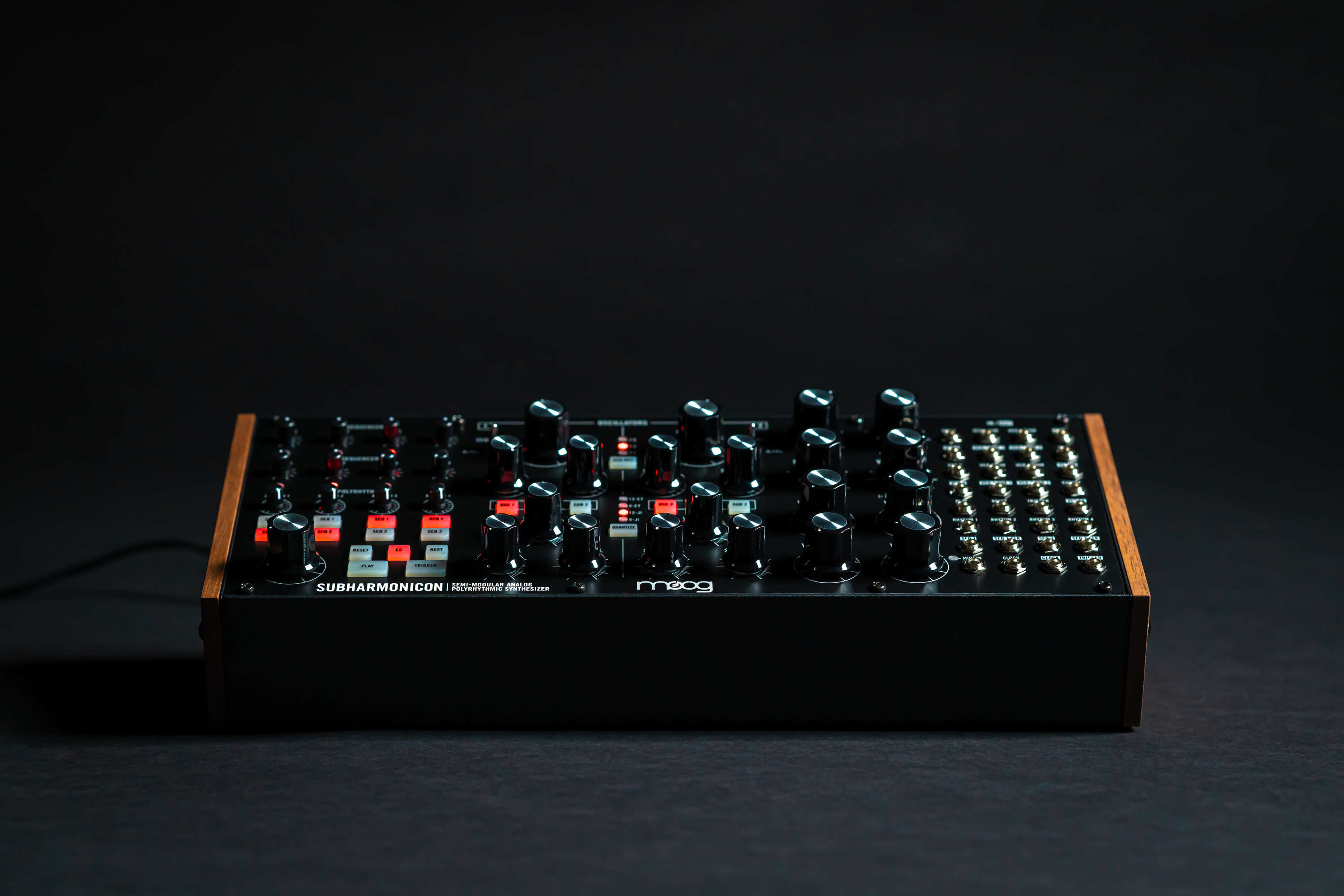
Quick and easy Pure Data tutorial, making chords from subharmonics (like the Moog subharmonicon). The result is a kind of Coltrane-y generative music system.

Subharmonics are whole-number divisions of a frequency (as opposed to regular harmonics, which are whole-number multiples of a frequency). The resulting “subharmonic series” (or “undertone series”) is an inversion of the overtone series, with subharmonics getting closer the lower (i.e. higher division) that they are. Played together, these harmonics create harmonies quite distinct from those created with overtones.

I go up to the 9th subharmonic here, but of course you can just keep going.

There’s no talking on this one, just building the patch, and listening to it go.

More Pd Tutorials Here

Sound Synthesis and MIDI Fundamentals Playlist

I’ve been adding a few videos to freshen up my synthesis and MIDI microlecture series, tuning it up for the coming academic year.

Check it out here for a complete(?) introduction to sound synthesis, from defining sound to modulation synthesis.

These lectures are an adaptation of lectures from a course I’ve been teaching for 13 years. I first taught it as a graduate student at the University of Oregon, then as faculty at the University of Montana, and I currently teach at the University of New Haven.

Of course these lectures have been continuously revised and refined over the years, but the fundamentals of synthesizing sound remain the same.

Pure Data Ring-Modulation Delay

A quick and easy Pure Data patch-from-scratch tutorial building a feedback loop with a delay and a ring modulator.

With just two sine waves, a delay, and some feedback, we can make some pretty complex and dynamic sounds! In this patch we take a sine wave, delay it, and then ring-modulate that delay before feeding it back on itself (feeding it back into the delay, that is).

There’s no talking on this one, just building the patch, and listening to it go.

More Pd Tutorials
More on modulation synthesis

Understanding Mid/Side Stereo in Synthesis (Pure Data, Reaktor, and Eurorack)

Mid/Side is a different way of working with stereo, where, rather than one channel for the left, and one for the right, you have one channel for the “mid” information, and one channel for the “side”. This format allows for different approaches to stereo processing, playing with the stereo image in new and interesting ways.

I’ve seen a lot of videos about mid/side for mixing or mastering but I thought I’d talk a bit about the potential for this approach in sound design, and how it can help us think about 3D audio and ambisonics too.

Modules in the Eurorack modular demonstration:
-Winterbloom Castor&Pollux dual oscillator
-Shakmat SumDif precision adder
-Hikari Instruments Ping Filter
-Instruo Tanh saturator

Feedback Loops with Cheap Stuff

Create dynamic feedback loops on a cheap mixer and pedals. With just a few pieces of equipment you can make wonderful, interactive, and unpredictable sound systems.

Over the summer, I’ve been thinking a lot about feedback and how simple devices can create complex sounds when fed back into themselves. Alongside checking out a lot of great music, I’ve been reading about 1950s “Cybernetics” and 1990s Japanese “Noise Music”, and considering the expressive possibilities of resonance and feedback. In this video I show a simple way to put together a noisy feedback loop setup with inexpensive equipment I had sitting in my drawer.

Further Study:

Sarah Belle Read’s Tutorial on No-Input Mixing


La Synthèse Humaine, Feedback Loops Explained and Demonstrated on Serge Synthesizers

Norbert Wiener, “The Human Use of Human Beings” (1950)


David Novak, “Japanoise: Music at the Edge of Circulation” (2013)

Making a Wavefolder in Reaktor 6 Primary

In this week’s video, we make a wavefolder in Reaktor, slowly adding features, and testing out some different types of waveforms.

It’s not terribly effective to filter sine waves, since they only consist of a single frequency, but, using a wavefolder, we can add harmonics, and create a rich, customizable sound.

Wavefolding is distortion of a waveform where, when the input amplitude exceeds a threshold, it becomes inverted. This adds harmonics to the sound (specifically odd harmonics), and, by controlling the amount of fold, we can modulate these in real time.

Making Binaural Beats in Pure Data (Brainwave Entrainment)

Talking about binaural beats, claims about their ability to entrain brainwaves, and walking through how easy they are to make yourself in Pure Data.

In binaural beats, two pitches with slightly different frequencies are played, one in each ear, supposedly creating a vibration at the difference tone inside your head, which can be used to entrain your brainwaves to help you relax, get you high, or even affect your behavior. The science isn’t there, but that doesn’t mean we can’t embrace binaural beats as a musical aesthetic, using Pd to make a fun, free “healing music generator.”

…just as long as we use our critical thinking and our ability to find credible resources.

Please TRUST YOUR DOCTOR (not the internet, including my videos) when making your medical decisions.

Synth Tip: Don’t Filter Sine Waves

Since sine waves are made up of only a single frequency, it’s not usually particularly effective to filter them.

Several of my students sent me Reaktor ensembles with filtered sine waves, so I wanted to quickly talk through why they’re not really the most effective thing to filter. I go through things in Native Instruments Reaktor, but the concept is applicable in whatever synthesis environment you’re working in–Pd, Max/MSP, Kyma, etc.